Showing posts with label Astronomy. Show all posts
Tuesday, 29 October 2013
Cranfield Astronomical Society
I have started attending an astronomy class at Cranfield University, which is just a short evening class for 8 weeks run by Cranfield Astronomical Society. They give some short talks each week and then if the weather is good, are eager to get outside and get some kit out to look upwards.
Last night was the first night we went outside (only my second week to be fair - last week was thunder storms!). It was cold and really clear. They have a small observatory with the main bit of kit being a Celestron C11. I didn't get a chance to look through the C11 as there were quite a few others lining up for a go and to be honest I was more interested at that point seeing what was going on outside.
They also set up a 80mm refractor, a 100mm refector and a 10" Dobsonian.
I cannot remember the guy's name, but he was setting up his personal kit, which consisted of a hefty go-to motorised mount, I can't remember exactly, but it was some Newtonian reflector ~11" telescope (big bugger), with a really cool auto-tracking system, which uses a smaller telescope mounted on the side with a webcam, which is connected to a computer and watches the stars and drives the mount accordingly. Onto this he could then mount a modified Canon D500 DSLR to do some deep sky object photography.
The mount can auto-track itself, but when trying to photograph long exposures of deep sky objects, even the slightest mis-track would result in a blurry image.
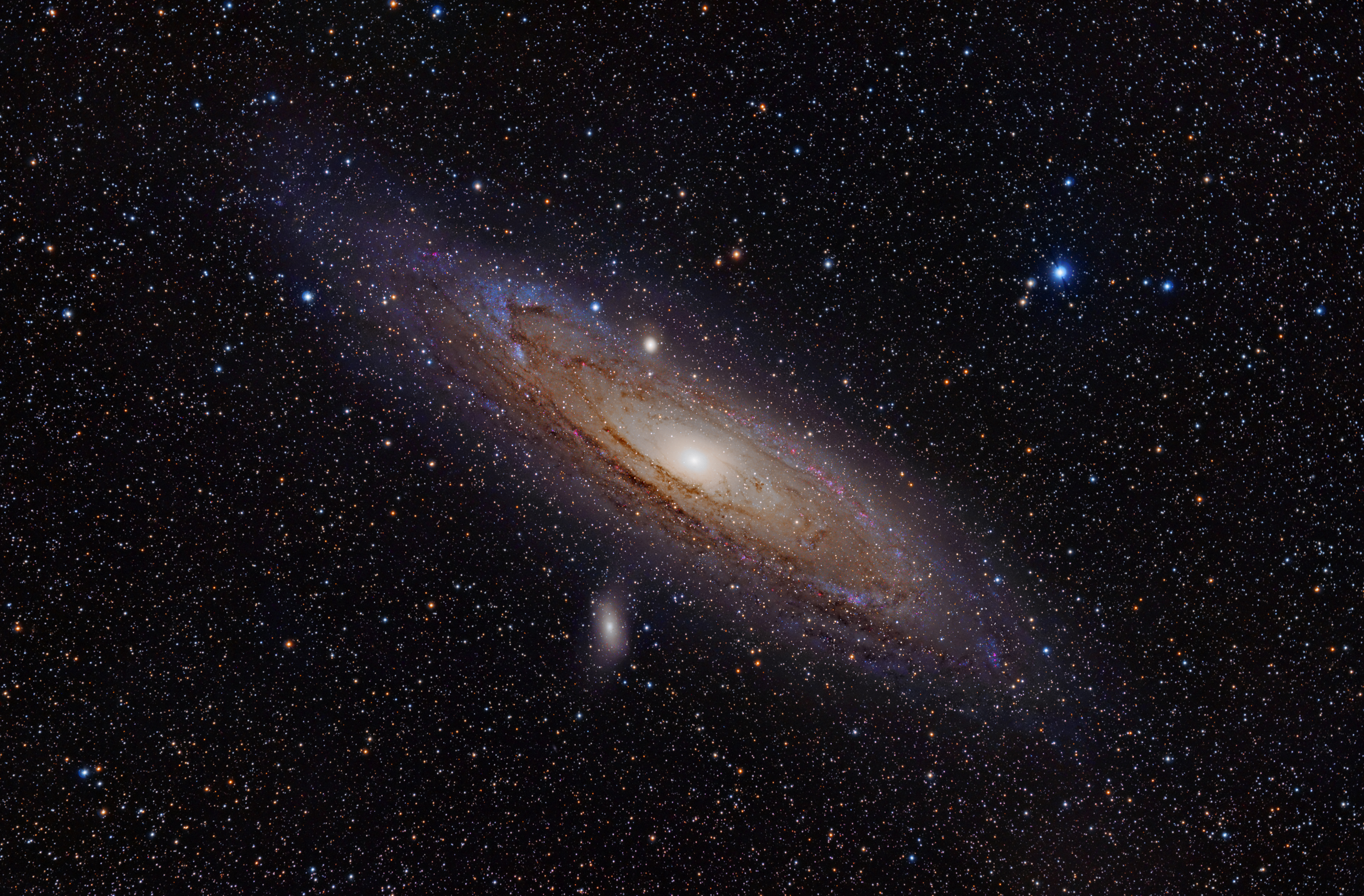
Last night he was photographing M31, the Andromeda galaxy, a favourite galaxy of many as it is one of the closest galaxies to us. It is the closest spiral galaxy, but the closest overall galaxy. It is 'only' approximately 2.5 million lightyears (not 200 million as unfortunately 2 astronomers at the class said it was, which I knew was wrong, but I wasn't about to start correcting people) from us. Small-ish in universe scales, but to us humans, so very, very far (23,668,200,000,000,000 km). Very far but also it means that as we look at it (possible with the unaided eye on a good night), we are seeing it as it appeared about 2.5 million years ago. So even as a close neighbour, we can only see what it was up to 2.5 million years ago. That could start a whole other discussion about why this buggers up ideas of making contact with 'things' in other galaxies (with current technology).
But, anyway, this guy was taking 2 minutes exposures (ISO 800) and every photo was just mind blowing. You could zoom in and see the dust trails already, just in the raw, unprocessed image. It really brings it home that these things are real and there as this guy just pointed a camera at it and took its picture. I think so many people think astronomy is just pretty colourful pictures just like abstract paintings, failing to see that they are images of real things, just like if I took a photo of my cat or the clouds in the sky.
It is hard to perceive depth and 3D in these images as they are so far away, but that's what's good about M31, it is kind of side on, so you get a sense of it being a 'disc' in space, with the front dust trails getting in the way of the rest of it.
He is going to stack up several of these images (to improve the the signal to noise ratio), so I can't wait to see the final result.
To make things more interesting, Jupiter rose whilst we were out, so the two refractors were pointed at that and through the 100mm you could clearly make out two main bands around Jupiter...and of course the Galilean moons. I can just about make out the moons through my 15x70 binoculars.
I look forward to seeing more, hopefully through the C11 next time.
Wednesday, 1 February 2012
Another Moon Shot with Registax
Another attempt at a shot of the Moon using 14 images from my HS10 and then stacking them with Registax.
Still unsure whether there is a marked improvement over just one of the originals. Not sure if I need to try and get more images to start with...will try more next time.
Tuesday, 17 January 2012
The Earth Rotates 366.25 Times per Year
Statement: The Earth rotates on its axis 366.25 times per year
That is, when the Earth completes one whole revolution around the Sun (360 degrees), which is a year, it has rotated on its own axis 366.25 times.This is going to be old news to some people, but I think it will still catch a lot of people out. The obvious thing I am hoping you are wondering here is that you thought there were only 365 days in a year. Some of you will know there are actually 365.25 days in a year, hence the reason for a leap year every 4 years. But where does that extra rotation come from to make it 366.25?
Have a think before reading the solution below. Hopefully the wonders of jQuery will have hidden it from you until you click.
The Moon and Registax
As part of my goal this year to get more knowledgeable on astronomy, I finally got round to trying out Registax to stack some photos I took of the Moon ages with this very thing in mind.
I always wanted to try this out but to date did not have a computer powerful enough to really do it. But that has recently changed as I finally have a decent computer in the form of a Dell XPS 15, which I must say is rather nice! Its an i7 with 4Gb of ram so it will serve purposes such as using Registax perfectly. This is compared to my Samsung N130 netbook, which was my main computer before, with its little 1.6GHz Atom processor.
Anyway, I know with most astrophotography that is built up from stacked images, the source is usually a video feed, which I guess is like having lots of individual photos, but combined in a video. Registax pulls out the individual frames like photos anyway. I had 5 photos that I took on my Fujifilm HS10. I took them as a 'burst' so they were all within about 1 second, so little movement between shots (not that it really matters).
I always wanted to try this out but to date did not have a computer powerful enough to really do it. But that has recently changed as I finally have a decent computer in the form of a Dell XPS 15, which I must say is rather nice! Its an i7 with 4Gb of ram so it will serve purposes such as using Registax perfectly. This is compared to my Samsung N130 netbook, which was my main computer before, with its little 1.6GHz Atom processor.
Anyway, I know with most astrophotography that is built up from stacked images, the source is usually a video feed, which I guess is like having lots of individual photos, but combined in a video. Registax pulls out the individual frames like photos anyway. I had 5 photos that I took on my Fujifilm HS10. I took them as a 'burst' so they were all within about 1 second, so little movement between shots (not that it really matters).
Tuesday, 12 April 2011
A Photo Of The Moon
A photo I took of the moon with my HS10. I used the 'A' (Aperture priority) mode, set AE to 'spot' and maximum F number for the aperture (smallest physical aperture).
Friday, 24 September 2010
The Moon, Jupiter and Galileoscope
Last night I went out to look at the pretty much full moon. It was really bright last night! Illuminating the garden enough to easily read a book by.
Whilst looking at the moon, Jupiter was VERY visible to the lower right of the moon, less than a fist's width away! Was an awesome sight. Jupiter has just (in the last few days) passed a point where it was closest to Earth for some years and is just past opposition.
I couldn't get over how bright Jupiter was so I did what any good geek would do and got my binoculars out. Whilst collecting my binoculars I thought, hmm, may as well grab my Galiliescope as well.
I bought the Galileoscope last year when they first started releasing them. I have had a few plays with it but not a lot. I only have a camera tripod (which is better than no tripod!) and keeping it steady and navigating the sky can be tricky. But I have seen Mars through it and also had a nice view of the Orion Nebula. The Orion Nebula was definitely recognisable as a cloudy splurge, which was enough to get me excited and Mars was still just a round dot, but it was nevertheless a disc as opposed to just a point of light. Also it was a bit 'salmony' pink in colour, making it definitely more than just a star (by star I just mean point of light).
But last night, I looked at Jupiter firstly with my binos and even though it was hard to hold them steady, I could definitely detect it was a disc not a point of light. And I could also, for the first time, distinguish what looked like a moon of Jupiter to it's side!! I was amazed that I could make that out with just my binos!
So I got the Galileoscope quickly set up and pointed it at Jupiter. It was tricky getting the telescope to point at Jupiter, firstly to actually aim it at it and secondly to finely adjust the direction it was pointing was impossible with my camera tripod. It was a case of squeezing it in the direction I wanted to move, over-shoot, knowing it would spring back to where I want. Not very clever but all I could manage. Also, I had to ensure no single part of me touched the scope or tripod as it just wobbled like mad.
But it was worth it! I got a view of Jupiter through the scope and was able to distinguish definitely three of the four Galilean (quite fitting with my scope) moons! I was again amazed. Not only could I make out the moons, but I could also just about make out a band roughly around Jupiter's equator!!! It was mostly a bright white disc, but definitely with a slightly darker band around the middle.
I was chuffed! Can easily see why people get the bug and want bigger and better telescopes all the time. I will definitely, when life/finances allow, get myself a decent telescope one day.
Whilst looking at the moon, Jupiter was VERY visible to the lower right of the moon, less than a fist's width away! Was an awesome sight. Jupiter has just (in the last few days) passed a point where it was closest to Earth for some years and is just past opposition.
I couldn't get over how bright Jupiter was so I did what any good geek would do and got my binoculars out. Whilst collecting my binoculars I thought, hmm, may as well grab my Galiliescope as well.
I bought the Galileoscope last year when they first started releasing them. I have had a few plays with it but not a lot. I only have a camera tripod (which is better than no tripod!) and keeping it steady and navigating the sky can be tricky. But I have seen Mars through it and also had a nice view of the Orion Nebula. The Orion Nebula was definitely recognisable as a cloudy splurge, which was enough to get me excited and Mars was still just a round dot, but it was nevertheless a disc as opposed to just a point of light. Also it was a bit 'salmony' pink in colour, making it definitely more than just a star (by star I just mean point of light).
But last night, I looked at Jupiter firstly with my binos and even though it was hard to hold them steady, I could definitely detect it was a disc not a point of light. And I could also, for the first time, distinguish what looked like a moon of Jupiter to it's side!! I was amazed that I could make that out with just my binos!
So I got the Galileoscope quickly set up and pointed it at Jupiter. It was tricky getting the telescope to point at Jupiter, firstly to actually aim it at it and secondly to finely adjust the direction it was pointing was impossible with my camera tripod. It was a case of squeezing it in the direction I wanted to move, over-shoot, knowing it would spring back to where I want. Not very clever but all I could manage. Also, I had to ensure no single part of me touched the scope or tripod as it just wobbled like mad.
But it was worth it! I got a view of Jupiter through the scope and was able to distinguish definitely three of the four Galilean (quite fitting with my scope) moons! I was again amazed. Not only could I make out the moons, but I could also just about make out a band roughly around Jupiter's equator!!! It was mostly a bright white disc, but definitely with a slightly darker band around the middle.
I was chuffed! Can easily see why people get the bug and want bigger and better telescopes all the time. I will definitely, when life/finances allow, get myself a decent telescope one day.
Subscribe to:
Posts (Atom)


